
Shopping Cart
There are no more items in your cartTipos de lavavajillas industriales: Cuál necesita tu negocio Horeca

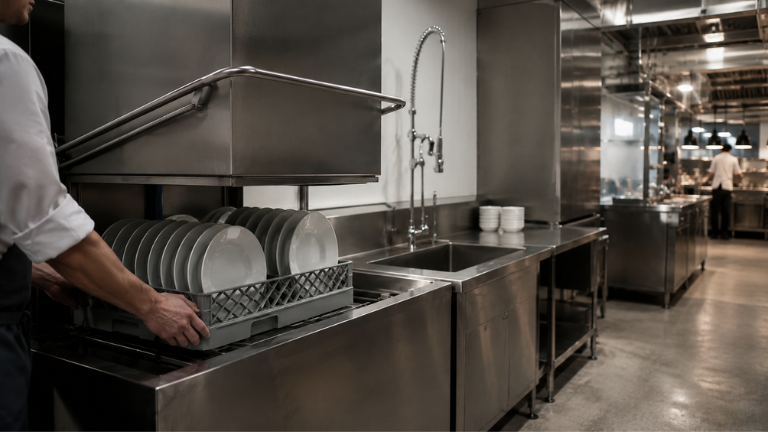
Choosing an industrial dishwasher shapes the day-to-day operations of any professional kitchen: it
ensures that dishes are available on time for every service and that food safety regulations
are met. A poorly sized unit becomes a bottleneck; one
that’s chosen wisely will operate for years without any problems.
Why Choose an Industrial Dishwasher Over a Household One?
The difference isn’t just a matter of size. A household dishwasher has cycles lasting 60 to 90 minutes, and
the rinse temperature rarely exceeds 70 °C. An industrial dishwasher operates with cycles ranging from 90 to 120
seconds and guarantees a rinse cycle starting at 85 °C—the temperature at which the most common pathogens found in professional kitchens
are destroyed.
That difference is not a technical nuance: it is a legal requirement. Regulation (EC) No. 852/2004
on the hygiene of foodstuffs mandates effective cleaning and
disinfection procedures, which in practice requires that tableware reach those
rinse temperatures. Furthermore, speed changes the operational logic: with a 90–120-second cycle,
a glasswasher can process up to 1,500 pieces per hour—a pace that a household appliance
cannot come close to matching.
How It Works on the Inside
The system uses two tanks: the main tank, which keeps the wash water hot and in
recirculation, and the boiler, which maintains the clean rinse water at a higher temperature.
Since the water is already hot at startup, the cycle takes minutes rather than an hour. The process
in a nutshell: manual pre-wash to remove solid debris, pressure washing with detergent through the
wash arms, and a final rinse with clean water and rinse aid that washes away the detergent and
leaves the dishes ready to air dry.
Types of Industrial Dishwashers
35×35 and 40×40 basket-type glasswashers. These are the most compact models, designed for under-counter installation
requiring only a water supply and drain. Ideal for washing glassware in bars and cafes, with
starting prices around 1,300–1,500 € and processing capacities ranging from 900 to 1,500 pieces per hour. With
proper maintenance, they can have a service life of over 10 years.
Front-loading dishwasher. The standard choice for small and medium-sized restaurants: universal
baskets measuring 500×500 mm that accommodate plates up to 320 mm. Entry-level prices
are around €1,300, with mid-range models costing between €2,500 and €2,900 and throughput ranging from 30
baskets per hour. Water consumption per cycle ranges from 1.7 to 3 liters depending on the model, which
makes a significant difference for a 100-basket service.
Dome-type dishwashers. The basket is loaded horizontally, and a dome is lowered to
cover it, with cycles lasting 60–90 seconds. These are the standard machines in kitchens serving more than
100 covers, as well as in hotels and institutional settings. Entry-level prices range from around 3,100 to 3,900
€, with higher-capacity models costing over 4,400 €. As a rule of thumb, it’s best to
calculate one unit for every 60–80 place settings at maximum simultaneous service capacity.
Utensil rack. Designed for pots, GN containers, and baking sheets that do not fit in a
standard basket. This is the highest-cost category, ranging from just over €7,000 to more than
€12,000 for versions intended for large commercial kitchens, but it eliminates the need to wash large items
by hand, saving operators between 15 and 20 minutes per service.
Conveyor tunnel. For institutional settings and high-volume catering: the baskets move automatically
through the wash stations without stopping the line.
How to Calculate the Production You Need
The most common mistake is sizing equipment for average service, not for peak demand.
A simple method: count the number of place settings for your busiest service of the week, multiply that by the
number of pieces of tableware per guest (8–12 in a standard restaurant, 5–7 for a daily special), divide
the total by the number of minutes available before the next shift, and choose a team with at least
20% more output than that minimum, to account for breakdowns or incomplete orders.
For reference: a bar serving up to 60 customers typically requires 600–900 pieces per hour (glasswasher);
a small restaurant, 30–40 baskets per hour (front-loading); a medium-sized restaurant, 40–60 baskets per hour
(infeed hood); and a large restaurant or hotel, 60 or more baskets per hour (high-production hood).
Factors to Consider Before Buying
- Rinse temperature: 85 °C or higher, as verified in the technical data sheet.
- Water consumption: The efficient range is between 1.5 and 3 liters per cycle.
- Water softener: In areas with hard water, it extends the equipment’s service life by 30% to
50%. - Electrical connection: Front-loading machines and glass washers are typically single-phase; high-
, hood-type machines may require three-phase power. - Dish space and height: Measure the available space; most racks can hold
items up to 280–320 mm.
Essential Maintenance
Most malfunctions have the same cause: dirty filters and clogged wash arms.
It is advisable to check the detergent and rinse aid at the start of the shift, clean the filters and sump
between shifts, ventilate and inspect the wash arms at the end of the day, degrease them
weekly, and perform an annual technical inspection of the pump and injector system.
Conclusion
No industrial dishwasher is inherently better than another: there is simply the right equipment for each business’s
service volume, space, and type of dishware. At Pilsa, we analyze the
actual service volume of each kitchen to recommend the equipment you truly need—
—without oversizing or undersizing it.
Discover our entire line of commercial kitchen equipment and find the right
industrial dishwasher for your business: www.pilsa.com/105-maquinaria.