
Shopping Cart
There are no more items in your cartCocinas Industriales: Gas, Inducción o Eléctrica, Cómo Elegir la Adecuada
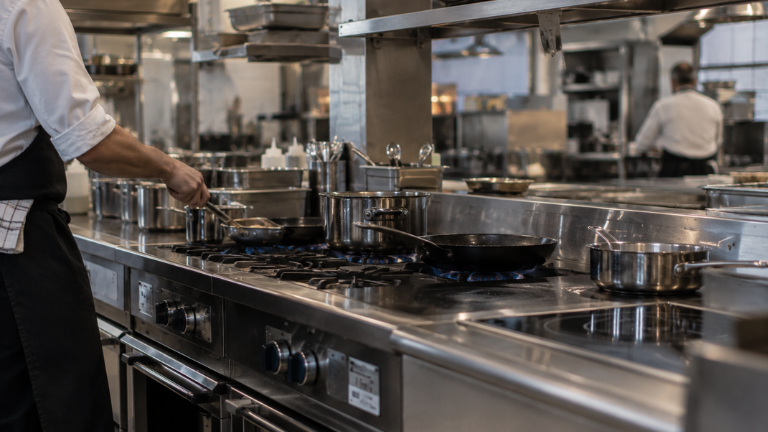
Choosing the commercial kitchen for a hospitality business is one of the decisions that most
influences day-to-day operations. It affects work speed, energy consumption,
maintenance, and profitability. The most common question among those setting up or renovating
a kitchen is always the same: gas, electric, or induction? In this guide, we review the
differences between the three types, how many burners and what power each business needs, and what
factors to consider before buying.
What Is an Industrial Kitchen?
When we talk about commercial kitchens, we’re referring to the stoves used for cooking
in a professional setting, whether as standalone units or integrated into a modular cooking line
. They are designed to operate for many hours a day at a high intensity:
boiling, sautéing, reducing, browning, or simmering in containers of various sizes, repeatedly and without
losing performance during peak service times.
There are three main types based on their technology: gas, electric, and induction. All three are
commonly found in bars, restaurants, cafes, central kitchens, cafeterias, food
trucks, and food preparation areas, although each is better suited to a specific type of operation.
How Many Stoves Does Your Business Need?
There is no standard number of burners: it depends on the size of the establishment, the type of menu, and
the volume of diners. As a general guideline: a tapas bar typically uses 2 medium burners
; a café serving basic dishes uses 2 burners plus one large one; a restaurant with
a varied menu needs between 4 and 6 burners of different sizes; a medium-to-high-volume operation or one offering
a daily special usually requires 6 large burners; and a food truck with a limited menu can
get by with 1 or 2 compact burners.
How much heat does each burner need?
Power is measured in kilowatts (kW) and determines how quickly food heats up, but it also
affects energy consumption. A small burner, ranging from 1.5 to 3 kW, is sufficient for small saucepans, frying pans, or
20-cm pots. A medium burner, ranging from 3 to 5 kW, is suitable for casseroles and pots measuring 30–35 cm. A large burner, ranging from
5 to 8 kW, is designed for large-volume pots, paella pans, or industrial kettles. It’s a good idea
to have at least one large burner if the business prepares soups, stews, or pasta in
large quantities; in small kitchens, it’s preferable to prioritize medium-sized burners.
Gas, Electric, or Induction: The Real Differences
Gas stove. It offers an immediate heat response and direct visual control of the flame, and
is compatible with any type of cookware. It continues to operate during power outages,
making it particularly reliable for continuous operation. On the other hand, it requires more
maintenance and cleaning of burners and grates, as well as a certified technical installation. It is the
traditional choice for restaurants that use high heat and have consistent volume, such as steakhouses,
grills, or Mediterranean cuisine.
Electric stove. It is easier to install and operates more reliably, with less
residual heat in the work area than a gas stove. Its drawback is a slower
initial heating time, and it stops working during a power outage. It is commonly used in small
kitchens, hotels, cafes, and food trucks, where convenience and cleanliness are prioritized over
raw power.
Induction cooktop. It is the most energy-efficient option and the easiest to clean and
maintain, in addition to generating less heat in the kitchen. It requires compatible cookware
and its initial cost is usually higher. Current models reach power outputs of
up to 5,000 W and, in many cases, can operate without requiring a three-phase electrical installation,
making them a solid alternative when there is no access to gas or when precise temperature control
is a priority.
In practice, many kitchens combine gas and induction by station, assigning each
technology to the cooking technique that best suits it. This hybrid setup allows
to balance speed and efficiency when preparing extensive menus or dealing with variable service peaks.
Do you need a three-phase installation?
It depends on the type of stove and its total power rating. Many electric and induction stoves
operate on single-phase power (230 V) when their power rating does not exceed 5,000 W. However,
if the premises will have several high-power appliances—stove, oven,
and dishwasher—a three-phase line (400 V) will likely be required. Before making a decision, it’s a good idea to
consult with a licensed electrician and verify the contracted power capacity for the premises.
Tips for Making the Right Choice
Beyond the technology, it’s best to size the kitchen based on actual peak production rather than
average service levels: a line that performs well on average may fall short during
peak hours if the cooking capacity can’t keep up. It’s also important to consider the techniques that account for
the bulk of the work—grilling, frying, stewing, and batch cooking—as well as the flow of
movement in the kitchen to avoid cross-contamination and wasted time, and ventilation, which must
be sized according to the actual thermal load. If the business plans to grow, a modular kitchen
makes it easier to adapt the layout in phases without oversizing it from the start.
The most common mistakes when designing a commercial kitchen are calculating based on average capacity rather than
peak capacity, failing to plan the workflow, underestimating dishwashing needs, and choosing technology without
considering the available electrical or gas infrastructure.
Conclusion
No single technology is inherently better than another: the right kitchen depends on the actual volume
of work, the cooking techniques used on your menu, and the space available at your location. Gas
remains a solid choice for high-volume operations and high heat; electric
works well for small kitchens with simple setups; and induction is gaining ground where efficiency, cleanliness, and temperature control
are prioritized. At Pilsa, we help every HORECA business identify the
cooking line that best fits its actual operations.
Check out our selection of gas, electric, and induction commercial stoves, and find the right equipment for your business at
: www.pilsa.com/105-maquinaria.